

Potential PhD Topics
PhD Supervisors
Below are listed those CAS staff who may be currently looking for PhD students.
- Dr. Rebecca Allen
- Prof. Matthew Bailes
- Dr. Kirsten Banks
- Prof. Chris Blake
- Prof. Jean Brodie
- A. Prof Michelle Cluver
- Prof. Jeff Cooke
- Prof. Darren Croton
- Dr. Rebecca Davies
- Prof. Adam Deller
- Prof. Alan Duffy
- A. Prof. Deanne Fisher
- Prof. Christopher Fluke
- Dr. Chris Flynn
- Prof. Duncan Forbes
- Prof. Karl Glazebrook
- Prof. Alister Graham
- Prof. Jarrod Hurley
- Prof. Glenn Kacprzak
- Prof. Virginia Kilborn
- Prof. Ivo Labbe
- Dr. Marcus Lower
- Dr. Ben McAllister
- Dr. Anais Möller
- Dr. Jade Powell
- Dr. Themiya Nanayakkara
- Prof. Michael Murphy
- Dr. Daniel Reardon
- Prof. Emma Ryan-Weber
- Prof. Ryan Shannon
- Dr. Simon Stevenson
- Prof. Edward N. Taylor
- Dr. Sara Webb
PhD Projects
The following projects have guaranteed funding
Searching for new cosmological physics in the large-scale structure of the Universe
(with Prof. Chris Blake)Tuning pulsar timing arrays to supermassive black hole binaries
(with Prof. Ryan Shannon, Prof. Adam Deller, Dr. Daniel Reardon, and Dr. Matt Miles; Vanderbilt)Mapping mass and motion in the local Universe
(with Prof. Edward N Taylor, A. Prof. Michelle Cluver, and Prof Matthew Colless; ANU)
The following projects are conditional on winning a competitive scholarship
Assembling Mass in the Dusty Cosmic Web
(with A. Prof. Michelle Cluver and Prof. Edward N Taylor)The Deeper, Wider, Faster program: Discovering the fastest bursts in the Universe
(with Prof. Jeff Cooke)Galactic Outflows and Galaxy Quenching
(with Dr. Rebecca Davies)Studying exploding galaxies with giant telescopes
(with A. Prof. Deanne Fisher)Project MINERVA: what lies beneath?
(with Prof. Karl Glazebrook)Galaxy Structure and massive black holes
(with Prof. Alister Graham)Mapping the Circumgalactic Medium Using Gravitational Lenses
(with Prof. Glenn Kacprzak and Prof. Karl Glazebrook)Axion Dark Matter Detection
(with Dr. Ben McAllister)Do the fundamental constants of nature actually vary?
(with Prof. Michael Murphy)
Project Descriptions - The following projects have guaranteed funding
Supervisors: Prof. Chris Blake

The "Lambda CDM" cosmological model, in which the energy of the Universe is dominated by a cosmological constant and cold dark matter, has provided the standard description of the Universe for the past three decades. However, evidence is emerging of discrepancies between different cosmological measurements, particularly the expansion rate of the local Universe or Hubble's constant, implying that this model is incomplete. This PhD project will focus on studying the cosmology of the low-redshift Universe, using the latest datasets including the large-scale structure of the Universe, distance indicators such as standard candles and gravitational-wave sources, and galaxy motions. We will use data from the largest galaxy redshift survey that currently exists, the Dark Energy Spectroscopic Instrument (DESI), to search for clues of new cosmological physics by bridging measurements and theory. The project will develop a complete set of research skills including statistical analysis, theory and simulations, and offers collaboration opportunities in one of the current leading international astronomical projects.

Supervisors: Prof. Ryan Shannon, Prof. Adam Deller, Dr. Daniel Reardon, and Dr. Matt Miles (Vanderbilt)

Pulsar timing arrays are Galactic-scale gravitational wave detectors that detect and study gravitational wave emission from the most massive black holes in the Universe: supermassive black holes in binaries in the throes of merger, embedded in the centres of galaxies. Major pulsar timing array experiments recently announced compelling evidence for a gravitational-wave background: the sum of gravitational waves from all of the binary supermassive black holes in the Universe. This discovery has demonstrated the power of PTAs as a new tool to study the Universe. After a background is detected, the next signal to seek is that from an individual supermassive black hole binary.
In this project, you will develop algorithms and undertake searches for individual binary supermassive black holes with state of the art pulsar timing array data sets, including that from the Swinburne-led (MeerKAT pulsar timing array project. You will first develop methods to optimise the sensitivity of pulsars timing array to individual binary supermassive black holes. This will include using precise pulsar distance measurements to improve searches for individual black hole binaries, and sophisticated modelling to correct for systematics introduced by the interstellar medium. You will then conduct searches for individual sources with the MeerKAT PTA and International Pulsar Timing Array data sets. The results of the searches will be compared to models to better understand the demographics of supermassive black holes and how they shape galaxy formation and evolution.
This project is part of the ARC Centre for Excellence for Gravitational Wave Discovery (OzGrav): a virtual research centre that brings together researchers and students in Australian and around the world to undertake cutting edge research in gravitational waves and fundamental physics and astrophysics.
Image Credit: Carl Knox (Swinburne/OzGrav)
Supervisors: Prof. Edward N. Taylor Prof. Michelle Cluver and Prof. Matthew Colless (ANU)

The 4MOST Hemisphere Survey (4HS) will measure optical spectra and redshifts for 4.5 million galaxies across the entire southern hemisphere, with particular emphasis on galaxies in the relatively nearby (z < 0.15) Universe. The primary cosmology goal for 4HS is to map not only the cosmic density field – i.e. where galaxies are – but also the cosmic velocity field: real motions of galaxies through space, above and beyond the Hubble flow. The velocity field provides an instantaneous snapshot of the gravitational collapse of large-scale structure and so measures the cosmological growth rate of structure, which is an essential cosmological parameter (like H0 or Omega-matter). Even better: with a map of both the density field and also the velocity field, it becomes possible to measure gravity over the largest possible scales (from millions to billions of lightyears). Within its first year of operations (i.e. by mid 2027), 4HS will already be the best PV cosmology dataset ever assembled, in terms of number, volume, and quality; at the end of the 5-year survey period, when combined with other existing datasets, 4HS will provide a complete gravitational map of our Local Volume, out to distances of 400 Mpc and greater.
This project focuses on the early science potential from the first years of 4HS data, to identify and characterise the most significant gravitational structures in the Universe (i.e. superclusters and/or megavoids) and reveal their formation histories. As well as learning powerful and transferable data skills across data analysis, statistical modelling, and simulations, you will have the chance to make real and high-profile contributions within our global (and super friendly!) 4HS cosmology science working group, and especially with Australian collaborators including Matthew Colless and Ryan Turner (ANU) and Cullan Howlett and Khaled Said (UQ). This project has guaranteed funding (including travel) through an ARC Discovery Project.
The following projects are conditional on winning a competitive scholarship

Supervisors: A. Prof. Michelle Cluver and Prof. Edward N. Taylor
The 4MOST Hemisphere Survey is a 15 million AUD spectroscopic redshift survey led out of CAS (P.I. Michelle Cluver, Edward Taylor) which will generate the rigorous statistics required to fully explore the galaxy property–environment connection. However, an understanding of how dust measurements map to properties such as dust content, dust density and dust temperature is crucial for tracing the interstellar medium conditions of galaxies. Without this, an understanding of how star formation and its efficiency (or lack thereof) is connected to HI reservoirs will remain elusive.
This project will lead the effort in 4HS to use existing and new dust measurements to map the interstellar medium properties of galaxies to their evolutionary state. Thanks to a proprietary “gold standard” data set, this kind of pioneering investigation is possible for the first time and will provide a benchmark for future investigations of dust content. This project will use our group’s expertise in WISE mid-infrared research and proprietary data to explore the relationship between dust properties and environment, first in the nearby 2MRS Cosmic Web, and then extended to the 4HS Cosmic Web.
Supervisors: Prof. Jeff Cooke
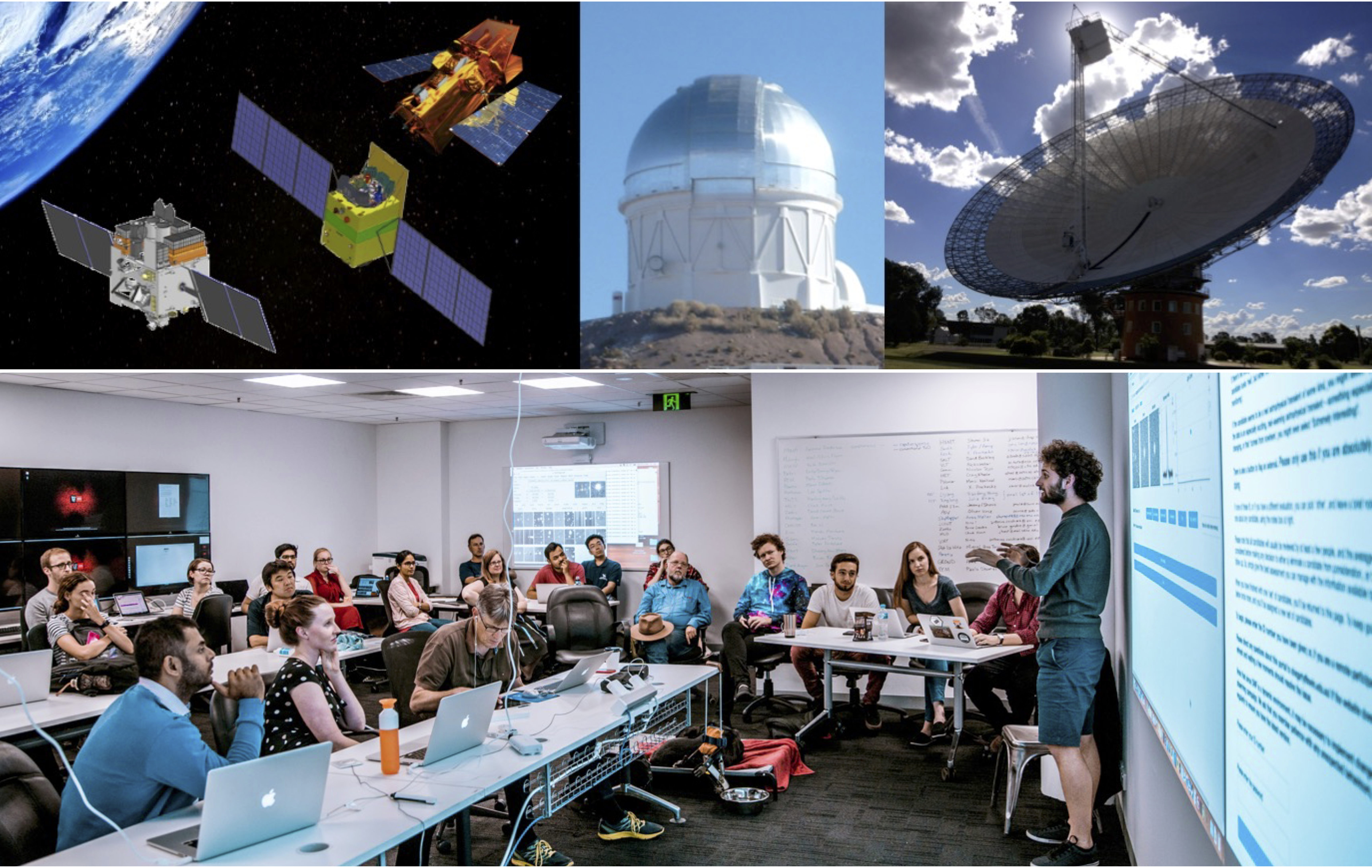
The Swinburne-led Deeper, Wider, Faster (DWF) program is the world’s first all-wavelength program designed to detect and rapidly follow up the fastest transients in the Universe. Fast transients include fast radio bursts, supernova shock breakouts, all types of gamma-ray bursts, kilonovae, flare stars, and many other events, including the potential discovery of unknown classes. DWF is the world's largest collaboration of telescopes, with over 90 major observatories on every continent and in space. For any given operational run, DWF coordinates roughly 10-15 wide-field radio through gamma-ray telescopes to observe the same fields at the same time. Telescopes such as Parkes and ASKAP (radio), CTIO DECam (optical), Astrosat (UV/X-ray), HXMT and Einstein Probe (X-ray), and NASA Neil Gehrels Swift Observatory (UV/X-ray/gamma-ray). These data are processed in real time and transients are identified within minutes of their outbursts in our Swinburne Mission Control room. Our fast transient identification enables rapid-response spectroscopic and imaging follow-up observations before the events fade using the world’s largest telescopes coordinated by the program, such as Keck, the VLT, Gemini-South, SALT, and the AAT (optical), ATCA (radio), and NASA Swift (high-energy), among others. Finally, our network of 1-2 metre-class telescopes located worldwide provide imaging and spectroscopy to monitor the events.
The student will analyse the unique multi-wavelength dataset in search of fast transients and early detections of longer-duration events to produce leading science. Depending on the student's interests and experience, the project will involve (1) developing techniques to search the deep, fast-cadenced optical dataset, (2) searching and cross-matching transients in the multi-wavelength datasets, and (3) enhancing transient discovery and analysis by progressing data visualisation and data sonification techniques. Project aims include extending our knowledge of known fast transient types, including providing new information on their progenitors, physics, environments, and explosion mechanisms, characterising the fast transient Universe for Rubin LSST and other upcoming deep surveys, and potentially discovering new fast transient classes.

Supervisor: Dr. Rebecca Davies
Why do massive galaxies stop forming stars? One of the prime suspects is galactic outflows – powerful winds driven by stellar explosions and black hole activity that eject gas from galaxies into intergalactic space. By removing the cold hydrogen gas needed to form new stars, these outflows may play a central role in transforming star-forming galaxies into the quiescent systems we observe today. In addition to regulating star formation, galactic outflows redistribute heavy elements such as carbon and oxygen, enriching the gas between galaxies and shaping the chemical evolution of the Universe. Despite their fundamental importance, outflows are extremely faint and difficult to observe, leaving many of their key properties, and their true role in shutting down star formation, poorly constrained.
This PhD project will use state-of-the-art observations from facilities like the James Webb Space Telescope, the WM Keck Telescopes and ESO’s Very Large Telescope to characterise galactic outflows in the early Universe. The student will measure outflow masses and velocities and relate these to galaxy properties to test whether winds are capable of quenching star-formation. The student will join a vibrant research group at Swinburne, working alongside 4 HDR students and international collaborators. The project will provide international travel opportunities for conference attendance, skill development and networking.

Supervisors: A.Prof. Deanne Fisher
In starburst galaxies, supernovae explosions push gas up out of the galaxy and into the cosmos above. We call these `galactic winds’. Galactic winds are considered by most theories to be a linchpin that regulates the growth of galaxies. I am starting up a project that uses Keck in combination with James Webb Space Telescope and Hubble to try to understand how outflows and superbubbles from stellar explosions drive galaxies in the early Universe. The project uses nearby galaxies that are extremely good matches for the conditions at z=6-10, and then carries out observations that are not possible to do at high-z. We are testing things like if intermediate mass black holes create outflows, and how the galactic winds might help reionization of the universe. The project will play a leading role a JWST Treasury program, called CLASSY, and we will work directly with the lead of that Prof Danielle Berg. At Swinburne you will work in a team of other PhD students and postdocs who work within our group. We will both use data that is ready for you to process, and make new observations on these large telescopes.
Further information:
- Galactic Winds Dictating Galaxy Evolution – 20 min Lecture by L. Zscaechner
- Cosmic Origins with Ultraviolet Vision Public Lecture by your future collaborator Danielle Berg
- How do outflows contribute to galaxy evolution?Talk by my former student
Supervisors: Prof. Karl Glazebrook

MINERVA is a new Treasury imaging survey with the James Webb Space Telescope (JWST) (260 hours of time) that will cover 548 arcmin^2 of sky with NIRCAM in 8 medium band filters covering wavelengths 1-5µm (see Muzzin et al. 2025, arXiv:2507.19706). MINERVA has just started taking data and will enable the exquisite measurements of the spectral energy distribution of objects in the z>3 Universe (26-35 total filters) allowing the determination of accurate redshifts for 13,000 galaxies, uncovering hidden population of objects and enabling a search for novel, rare and unusual objects in the early Universe. MINERVA also includes extensive MIRI images at wavelengths 10-20µm.
This PhD project is to work with the Prof. Glazebrook, and the international team, on the MINERVA survey. This is a fast moving project and research areas will be flexible according to interest and starting time. Particular areas of interest for projects at Swinburne are (1) the search for ancient quiescent galaxies (objects like the one recently discovered by Glazebook et al. 2024 (arXiv:2308.05606) that challenge ΛCDM models) exploiting the superior spectral resolution of MINERVA, (2) measuring the morphological properties of massive galaxies from the JWST imaging and how it depends on their 3D environment determined using accurate photometric redshifts, (3) using AI methods to identify novel classes of object from their multband photometry (4) investigating the nature of ’NIRCAM dark/MIRI bright’ sources.
Figure: Demonstration of the power of JWST medium bands. Discovery of a z=15.4 galaxy by Asada et al. 2025 (arXiv:2507.03124). The top panel show the 20-band photometry (broad+medium) which shows a convincing spectral energy distribution for such a high-z galaxy (lower left panel). The photometric redshift determination is only possible with this level of photometry (bottom right). See Asada et al. Figure 1 for more details.
Supervisors: Prof. Alister Graham
This project will explore how stars are distributed in galaxy images obtained from both ground-based telescopes and satellites such as Hubble and Spitzer. The structure of galaxies reveals much about how they formed, how they are connected with one another and also with the massive black holes that reside in their cores. This knowledge will be used to pursue a number of exciting topics at the forefront of astronomy. A feeling for the type of research done with Prof. Graham can be seen in his Press Releases.
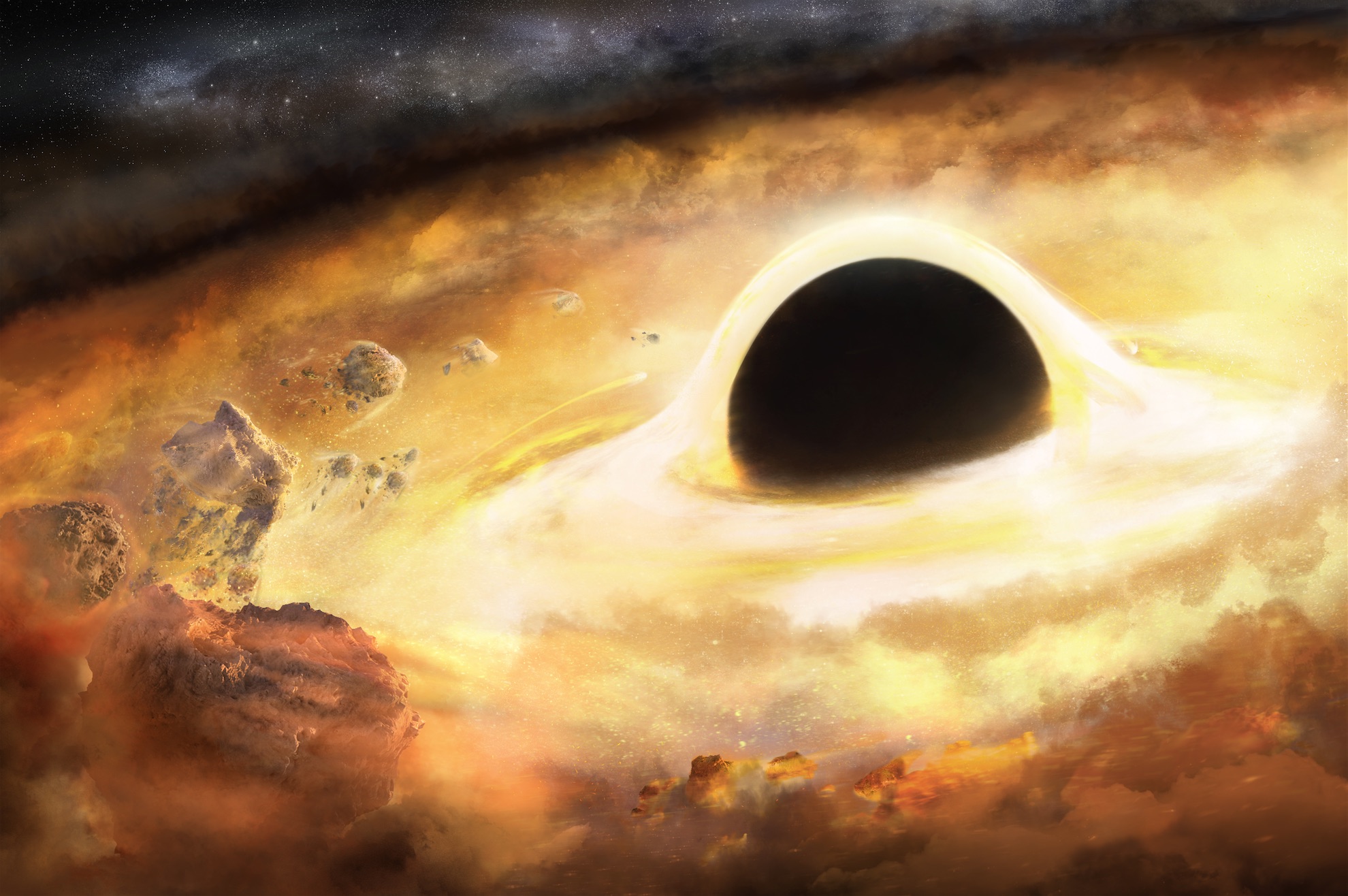
Image: Artistic impression of a black hole featured on the cover of Swinburne University's 2019 annual report. Credit: James Josephides and Alister Graham.

Supervisors: Prof. Glenn Kacprzak and Prof. Karl Glazebrook
The circumgalactic medium (CGM) is the diffuse gas halo surrounding galaxies. The CGM is fundamental to galaxy growth through processes such as gas accretion, star formation and feedback, yet its spatial structure and physical properties are poorly constrained because most studies probe only a single sightline through a galaxy halo. Gravitational lensing enables multiple lines of sight through the same foreground halo by magnifying and splitting the light of distant galaxies, providing a unique opportunity to map CGM absorption across separations from sub-kiloparsec to tens of kiloparsecs and study how metal enriched gas varies with position within the halo.
This project will use new data from the Keck Cosmic Web Imager and from our Team’s recently awarded VLT/MUSE Large Program VLT/MUSE of strongly lensed galaxies to measure CGM absorption towards multiple images of background sources. Combining detailed lens models based on high resolution imaging with spatially resolved spectroscopy will allow the student to determine gas spatial distribution, kinematics and ionisation structure as functions of impact parameter and foreground galaxy properties. This approach will provide the first systematic spatially resolved characterisation of CGM gas around galaxies at intermediate redshifts and advance understanding of gas flows that fuel or quench galaxy growth. The project is embedded within the AGEL collaboration, a large international team that combines gravitational lensing and spectroscopy to study the circumgalactic medium and galaxy evolution.
Supervisors: Dr. Ben McAllister
The nature of dark matter is one of the biggest mysteries in modern science – it makes up five sixths of the matter in the Universe, and is of unknown composition. It surrounds and passes through the Earth at all times.
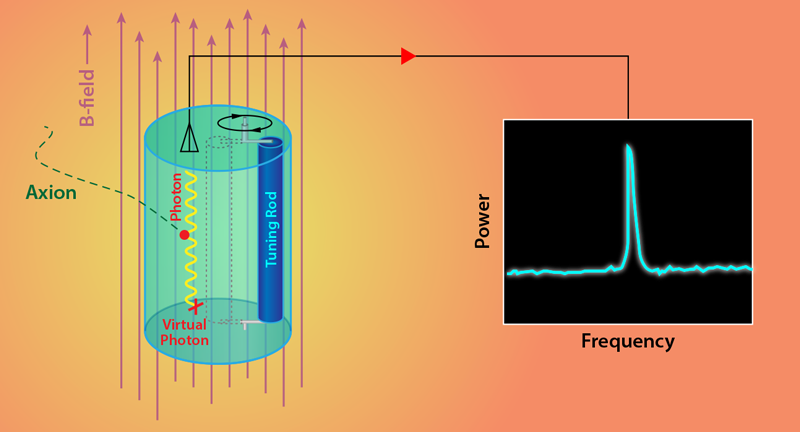
Axions are a hypothetical particle, and one of the leading candidates for dark matter. Swinburne is building a new axion detector to try and measure small effects induced by dark matter when it passes through the laboratory, and shed light on the mystery. The kind of experiment we are building is called an axion haloscope.
The detector is currently being constructed and will be hosted at Swinburne. There is work to be done on various aspects of the project, from optimal detector design, to manufacturing and characterisation, to advanced readout technology, to control software and data analysis.
This project could focus on any of these areas, tailored to fit the skills and interests of the candidate. There is room for multiple students, and you will be working in a small team with other researchers. For example, this project could include aspects of mechanical and RF design, material science, computational modelling, software to control the detector and associated equipment, or on a pipeline to acquire and tease through experimental data for hints of new physics.

Supervisors: Prof. Michael Murphy
The fundamental constants characterise the strength of nature's
forces. Their constancy has been tested in laboratories to
extraordinary precision, and they have been mapped across the
universe. But new theories, that go beyond the standard model of
particle physics, suggest these "constants" may vary where dark matter
is highly concentrated, like the centres of galaxies, including our
own. This PhD project will be part of an ongoing effort to map the
fine-structure constant – alpha, the strength of electromagnetism –
closer to our Milky Way's Centre. To measure alpha, we carefully
compare spectra of stars near the Centre, about 23,000 light-years
away, with very similar stars in our local region. We are currently
observing these stars with the Keck Observatory (Hawai`i), of which
Swinburne is a partner, and the Very Large Telescope (Chile). This
project will be mainly focussed on analysing the telescope
observations to measure alpha. However, it can also address issues of
stellar astrophysics using precise spectroscopy as well. These details
options will be discussed with the candidate. Further
reading: Murphy
et al. (2022, Science, 378, 634).