
Emission Line
An emission line will appear in a spectrum if the source emits specific wavelengths of radiation. This emission occurs when an atom, element or molecule in an excited state returns to a configuration of lower energy. Since every atom, element and molecule has a unique set of energy levels, the emitted photon (‘packet’ of radiation) has a discrete wavelength, and an energy equal to the difference between the initial and final energy levels.
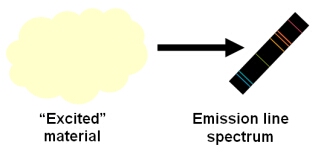
The spectrum of a material in an excited state shows emission lines at discrete frequencies.
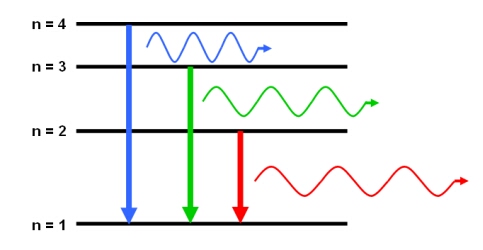
Photons with specific energies will be emitted by an atom, ion or molecule in an excited state. The energy is equal to the difference between the higher and lower energy levels. In this example, three different photon energies are emitted as electrons move from excited states (n=2,3 and 4) to the ground state (n=1).
Emission lines are usually seen as bright lines, or lines of increased intensity, on a continuous spectrum. This is seen in galactic spectra where there is a thermal continuum from the combined light of all the stars, plus strong emission line features due to the most common elements such as hydrogen and helium.
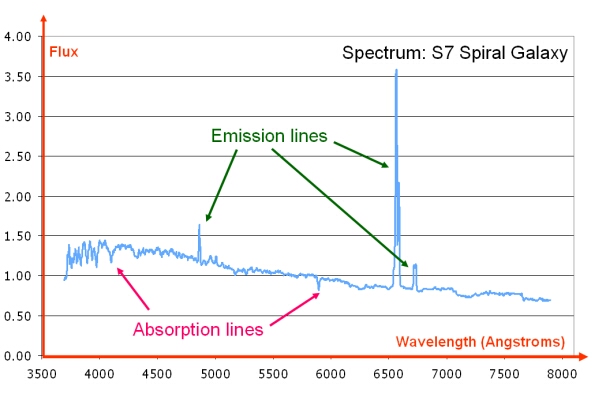
The spectrum of an S7 spiral galaxy showing emission and absorption line features superimposed on the continuum. Wavelength is measured in Angstroms, while the flux is in arbitrary units.
Dataset: VizieR catalogue III/219, Spectral Library of Galaxies, Clusters and Stars (Santos et al. 2002)
Dataset: VizieR catalogue III/219, Spectral Library of Galaxies, Clusters and Stars (Santos et al. 2002)
See also:spectral line.
Study Astronomy Online at Swinburne University
All material is © Swinburne University of Technology except where indicated.